
Your brain likes to generalize. It forms generalizations out of individual examples, similar to fitting together the pieces of a puzzle. This is more or less how we form concepts—by grouping together things, ideas and events with shared characteristics so to classify them. It’s an efficient way to give meaning to your world.
For example, when you first saw a comic strip you most likely didn’t know the concept of “comics.” But over time, you learned that certain styles of line drawings formatted in a sequence were referred to as comics. Once you formed this concept, it became easier to classify other examples of line drawings as comics or non-comics.
At a young age, we learn to form generalizations, such as the concept for “comics.”
Examples or instances seem to be crucial for helping a learner form accurate concepts. Otherwise, according to educational researchers, the learner can overgeneralize, under-generalize or form misconceptions. Here are six ways to help learners acquire concepts. In overgeneralization, a learner applies a rule to a concept or classifies an example to a concept when it does not apply. Their concept is too wide. In under-generalizing, a learner’s understanding of a concept is too limited. They may not think that an example is part of the concept when it is. Misconceptions involve a failure to comprehend a concept accurately.
Rule #1: Use examples in which the irrelevant attributes vary widely.
As learning designers, we can help by providing the right types of examples. Just any old examples won’t do. The attributes of the examples should vary widely, particularly on irrelevant characteristics, so learners get the right idea.
In a course on sexual harassment, if your examples only demonstrate a person harassing an individual of the opposite sex, a learner might erroneously generalize that sexual harassment cannot occur between people of the same gender. This, of course, is not true.
By varying the less relevant attributes of your examples, learners get a more refined understanding of a concept. Learners may form inaccurate concepts if the examples of the concept don’t vary widely on irrelevant attributes. This type of generalization is too narrow (Merrill & Tennyson, 1977).
Rule #2: Progress from simple to difficult examples.
It’s also important to start with simple examples at first, but progress to more complex ones later. Research shows that if a learner only sees simple instances of a concept, they will be less likely to classify the more difficult instances. This causes under-generalization (Merrill & Tennyson, 1978).
Imagine a radiologist learning about bone fractures. If the radiologist only learns how to identify the most obvious instances, in which the fragments separate completely, they will undergeneralize what a fracture is. Upon seeing a fracture in which the bone fragments are still partially joined, the radiologist could make a false diagnosis.
Rule #3: Present instances of a concept in rapid sequence or allow all instances to be viewed simultaneously.
Display examples close together in time. This enables them to be active in working memory all at once, facilitating the process of generalization. If there is a time gap between the presentation of examples, the learner might not generalize from them. So present examples in rapid sequence or leave several on the screen at one time (Gagne, 1985).
Rule#4: Use matched examples and nonexamples for concepts with related attributes.
Your brain also likes to discriminate. Discrimination restricts the range of examples we use to form a concept. To help learners form an accurate concept and to avoid overgeneralization, promote discrimination by presenting nonexamples. Nonexamples are an instance that is specifically not an example of the concept being learned. Nonexamples should vary in one attribute from the example with which it is paired.
Some research points to the fact that concepts with clearly distinguishable attributes (like texture versus color) are better taught with examples only. The learner only needs to generalize in order to acquire the concepts. But concepts that have common attributes, such as the statistical concepts of mean, median and mode, require discrimination skills and thus need matched examples and nonexamples (4). Matched examples and nonexamples should be present in working memory simultaneously.
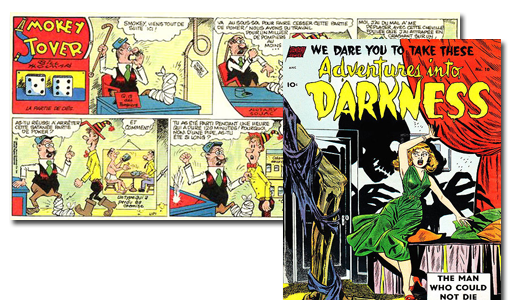
Back on the comics theme mentioned earlier, it’s difficult to fully define the concept of comics. So a paired example and nonexample can help, because discrimination is required. The pair below demonstrates that the intent of the artist is one attribute for defining comics. The example on the left was intended to be read as a comic book. Roy Lichtenstein’s comic-based painting on the right was intended as an artwork that provided commentary on the mass media.

Present matched examples and nonexamples when concepts could be confused with each other.
Rule #5: Provide opportunities for learners to generate their own examples of a concept.
If you’re working in a setting that allows learners to communicate with you and each other, ask them to generate their own examples of a concept. Promoting reflection and response in this way will reinforce well-formed concepts and correct misunderstandings. It may also clarify fuzzy areas, as not all concepts are neatly defined.
In the sexual harassment course mentioned earlier, a learner might come up with an example that asking a co-worker for a date is harassment. Others in the discussion would probably respond that this is not harassment, but that repeatedly asking the same co-worker for a date after multiple refusals might be harassment. This feedback corrects the misconception.
Rule #6: Expose learners to a wide range of examples and nonexamples and allow them to discover the concept.
We have been discovering concepts on our own since childhood. It’s a natural occurrence for a pattern-seeking brain. It’s not surprising then that an effective way to learn concepts is to discover them from interacting with a set of examples and nonexamples.
Using this inquiry strategy in eLearning isn’t quite as easy as in instructor-led training, but it can be done. It involves presenting multiple examples to the learner and inquiring about shared characteristics of the examples. Through exploration and discovery (interactive activities), learners can acquire the concept. Then use questions and context-sensitive feedback, to correct any misconceptions.
In a synchronous setting, concept formation can emerge from structured online discussions. Research seems to point to the fact that discovery learning is most effective when learners already have a developed knowledge base.
References:
- Gagne, Ellen. The Cognitive Psychology of School Learning. Brown Little, 1985.
- Merrill, M. D., & Tennyson, R. D. (1977). Concept teaching.An instructional design guide. Educational Technology.
- Merrill, M. D., & Tennyson,R . D. (1978). Concept classification and classification errors as a function of relationships between examples and non-examples. Improving Human Performance, 7, 351-364.
- Tennyson, R.D. and Cocchiarella, M.J. (1986). An Empirically Based Instructional Design Theory for Teaching Concepts. Review of Educational Research, Vol. 56, No. 1.
Get smarter about online learning with articles, tips and resources delivered to your Inbox once a month.
As a trainer, I believe it is crucial to understand how our learners learn and to implement effective strategies to help them solidly acquire key concepts. Another argument I would like to add is the importance of repetition and review to reinforce concept learning. By repeating and revising concepts at different times during the training, we can help learners retain them better and use them effectively in their daily work.
I appreciate your suggestions to allow the concepts to be discovered by the learners themselves. There are so many perspectives and an array of beliefs, viewpoints, etc. As instructors, it would be impossible to provide lessons designed for each individual. However, developing lessons that allow the different personalities to explore and discover concepts themselves is truly a strategy to ensure that all can learn.
Every progress is made from easier towards more difficult things. Examples shouldn’t be excluded 🙂