

In this interview, I discuss the 4Door™ eLearning Approach with Russ Powell, who worked with its creator, Thiagi.
COACH: Before we get into the 4Door™ eLearning Approach, can you give me some background on how it originated?
RUSS: I worked closely with Thiagi several years ago, and during that time, I picked up a saying of his that goes something like this, “In any given instructional project, the person who learns the most is not the student, but the instructional designer. It’s the instructional designer who combs through all the content, parsing and sorting as they go, deciphering the often poorly written material and trying to figure out what’s important and what’s not. If the ID learns more from all this “engagement” with the material—why not split some of that energy and activity with the student?”
COACH: What is the 4Door™ eLearning Approach?
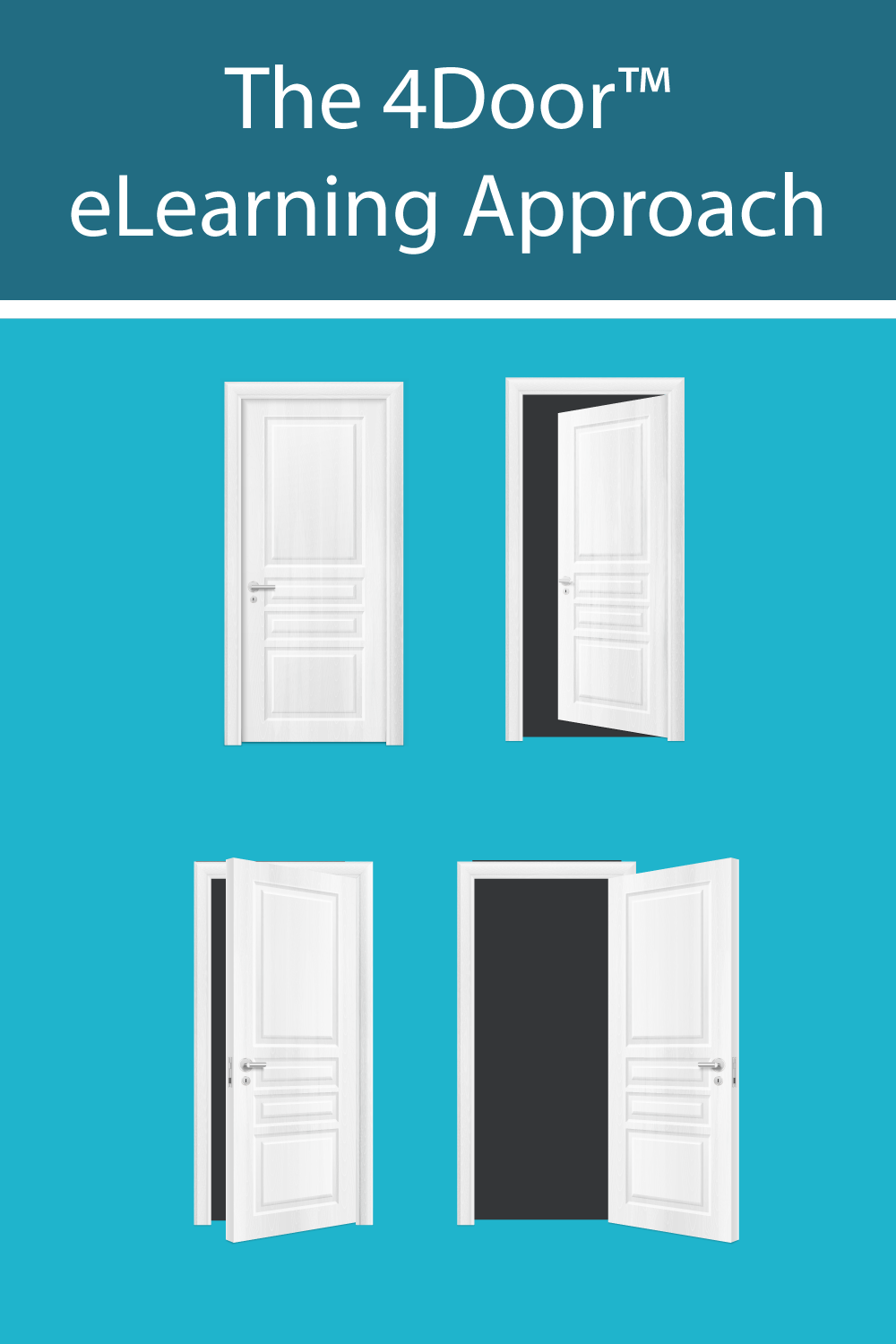
RUSS: The “four doors” represent four different areas or components of the learning environment: 1) The Library, 2) The Playground, 3) The Café, and 4)The Evaluation Center. [Note: You can rename any components for your unique audience, as shown in the screen sample.]
COACH: Would you explain each of the components?
RUSS: The Library contains the content of the course or module—the information required to master the learning objectives and to complete the final performance test successfully. It typically has pre-built or existing content, such as videos, documents, slide shows, photos, and audio files. We used anything with meaningful content that could be placed online. Then we invite learners to study the content in any way they prefer.
The Playground contains fast-paced frame-games that provide practice in recalling and applying the content from the library. They help increase fluency. The frame-games typically require the learner to type or choose short answers. Learners can play each frame game repeatedly at up to three levels of difficulty.
The Café contains social learning activities. A good example is the open-question game, which uses open-ended questions to encourage the learner to reflect on the content presented in the library. Learners respond to each question by typing an answer in a text box. When complete, the learner can review the answers from experts and fellow participants. The café may also include other social-learning components such as wikis, blogs, message boards, etc. Facebook and LinkedIn groups would fall under this category.
The Evaluation Center is simply the test center. It contains the performance test. Ideally, instead of using multiple-choice questions, the evaluation asks the learner to complete or participate in an actual job-related assignment.
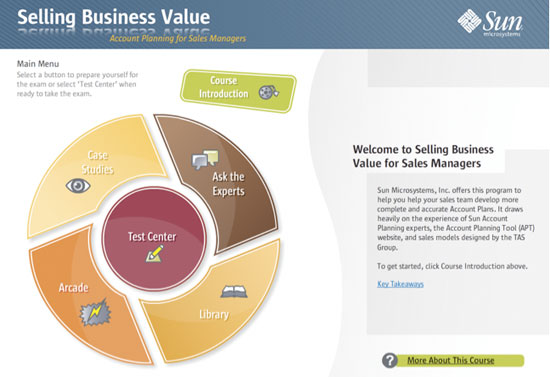
Home Page for a Thiagi Course. The Case Studies are part of the Library.
COACH: What would you say is the significance of this approach?
RUSS: There are two main reasons that it’s essential.
First, this model helps training and non-training professionals build instructional-savvy online training programs relatively quickly and cheaply. If you’re a subject matter expert with no training in instructional design and all you have is some guidance on how to “fill in” these four doors, you can build a reasonably good training program quickly and cheaply.
Second, it provides a nice alternative to what has become traditional online training. It’s an alternative that’s fast and cheap and offers more control to adult learners regarding how they learn.
COACH: What’s the best way to proceed through the 4Door™ eLearning Approach?
RUSS: That’s tough to answer. There’s no “best way.” Every learner will go through a 4Door™ course differently. I like the way Thiagi puts it.
- “If you are a law-abiding citizen, you may begin at the Library. Then, you proceed through the Playground and the Café to the Evaluation Center.
- If you are a wild and impulsive participant, you may hop, skip, and jump among the modules and sections. You may go to the Playground first and get trounced. You’ll find out what types of questions are there, and then work your way through the Library.
- If you feel lucky (or have a bloated sense of self-esteem), you may skip all the studying, go directly to the Evaluation Center, and complete the assignment.
- If you are a grasshopper, you can skim through the Library, jump to the Cafe, enjoy the frame-games in the Playground, and then return to the Library for some serious studying.
COACH: Does this approach entirely do away with the systematic content organization? Does the designer perform any instructional or content analysis?
RUSS: Yes and No. Let’s look at the Yes answer first. And let me start by saying that this model is EXTREMELY flexible. Also, when I say, “Yes, we’re doing away with instructional and content analyses,” we’re not really doing away with them altogether; we’re just doing them VERY quickly.
Let’s say you’ve got an instructional project to get out the door, and there’s virtually no time and very few resources available to do a thorough content analysis. With this, I’d sit down with the subject-matter expert(s) and determine a reasonable final activity—ideally, some task that can be done, observed, and qualified in the field. Then, we’d gather the most relevant and available content we could find that would support the performance of that activity and use it as is.
And the “No” answer to your question? That’s probably obvious. If you’ve got more time and resources, then yes, do more organizing and analysis—but not too much.
COACH: What types of content would you use?
RUSS: The content could be manuals, marketing material, videos, slide shows, white papers, etc. If there’s a lot of content, I’d lean on the SME to help me prioritize. We’d focus only on what’s MOST important—that which most directly supports the final activity.
COACH: So it’s kind of content analysis on the fly?
RUSS: When I ask the SMEs to think about good game items, they are performing a content analysis—choosing the most essential content. I might help them re-write some of the game items so they read well, but often, they can do this independently.
Earlier, you asked about organizing content. This model is self-organizing. The organization comes from the SME’s prioritization of content for the Library and the fact that games are in one place, primary content in another, social components in another, etc.
COACH: What are the advantages of a self-organized approach to instruction?
RUSS: In this model, there’s an assumption at play that suggests that if the content is a little less organized than it might be in other models, the students/participants have to engage with it more and, as a result, learn more from doing so.
While this might be a little awkward and uncomfortable initially, it mimics real life. We often find ourselves in awkward and uncomfortable situations, and I think we learn a lot from them. This model encourages a more significant investment on the part of the learner and, I believe, results in more “stickiness” and increased learning.
COACH: Can you tell us more about the frame games in the Playground?
RUSS: The frame-games in the playground provide review and practice opportunities. Although the frame-games may not be slick, with lots of bells and whistles, they offer the designer a quick and easy way to help learners engage with the content in an addictive way to test their knowledge.
More specifically, the games help learners:
- Recall and organize factual information
- Associate components with different stages and steps
- Emphasize critical features
- Identify major differences among concept classes
- Gain fluency in recalling information
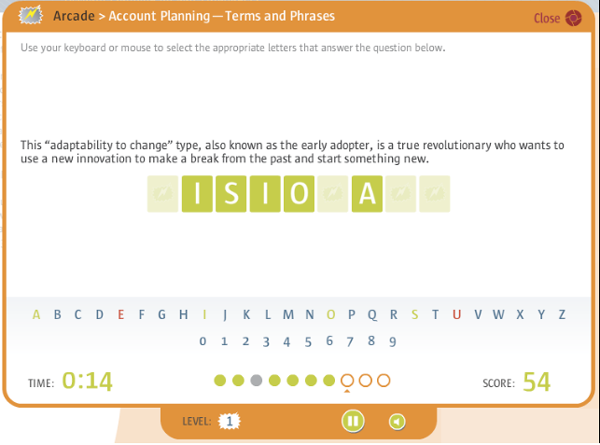
Example of a frame-game
COACH: Are the frame-games produced with a template in an authoring environment?
RUSS: Yes. At Sun Microsystems we had the luxury of building our own frame-games, but there are many tools out there for building frame-games. I think Thiagi is selling his frame-games from his website at thiagi.com at a very reasonable price. CarsonMedia has an eGame Generator too that I’ve used in the past , and Articulate QuizMaker has a handful of templates that can be used to build frame games. If any of your readers get stuck on this or want to build something of their own, have them contact me, I’d be happy to discuss ideas with them. (See the Resources listed below for links.)
COACH: Finally, how do learners who are used to more structured learning environments know where to start? Do you help them initially?
RUSS: In the four-door projects I completed for Sun Microsystems (now Oracle), we didn’t want to give the student/participant too much. We felt that encouraging the user to explore the content was a valuable thing. But we also had a lot of concerns about alienating or losing users who just weren’t interested in exploring the content.
We ended up doing three things to address this concern. The first, and probably most important was the design of the interface. We tried to make it somewhat intuitive and easy to navigate. We went through at least four or five designs before we settled on one. User feedback suggested that we chose an interface that was relatively easy to use.
The second was to include some linear learning paths in the Guide Me section. If users are overwhelmed or lost, they can go to Guide Me. There they will find documents that walk them through the course step-by-step. For example, “Step 1 – Go to the Library; Step 2 – Read the documents that are unfamiliar to you; Step 3 – Visit the Playground.”
The last thing is to include an introductory video on the main page. This provides a three-minute tour of the user interface and the content.
COACH: What kind of response did you get to this learning experience?
RUSS: The user feedback we received suggested that the vast majority of users enjoyed the exploration that the course encouraged. Very few people have trouble starting and very few become overwhelmed by the experience.
To summarize, the 4Door™ eLearning Approach combines the effective organization of online documents (in the library), with the motivational impact of frame-games (in the playground), the power of collaborative learning (in the café), and authentic performance tests (in the assessment center).
RESOURCE:
Learn more at Thiagi’s Site: The 4Door™ eLearning Approach.
Exciting to see some adventure in eLearning!
Connie, thanks for the opportunity to share my experience w/ this model through your blog. I’m glad to see positive responses about the approach.
Readers, if you’re interested in discussing more details of the model, feel free to contact me. RP
Hi Jay. Please share your experience with us when you try this approach.
I simply love this approach. You’re right in that it addresses so many issues currently associated with rapid eLearning development; it also would seem to provide a high probability of success for the instructional program. I too will look for a brave client to experiment with. Thanks for sharing. I look forward to part 2.
Hi Sheri. Thanks for your comment. Yes, I think this model could work for people who aren’t initiated into the world of ID, but I also think it would be even more effective if an experienced instructional designer were involved. It definitely has it’s place and usefulness. I look forward to trying it out on my next brave client!
Hi Jill. I’ll have the second half ready in a few days. Yes, it’s a fascinating model, yet at the same time, so straightforward and simple.
I have never heard of the four door model before. It’s concrete, making it a model that would translate well for those unfamiliar with learning theories or design. I also like that the evaluation piece would strive to go beyond testing. Thank you for sharing.